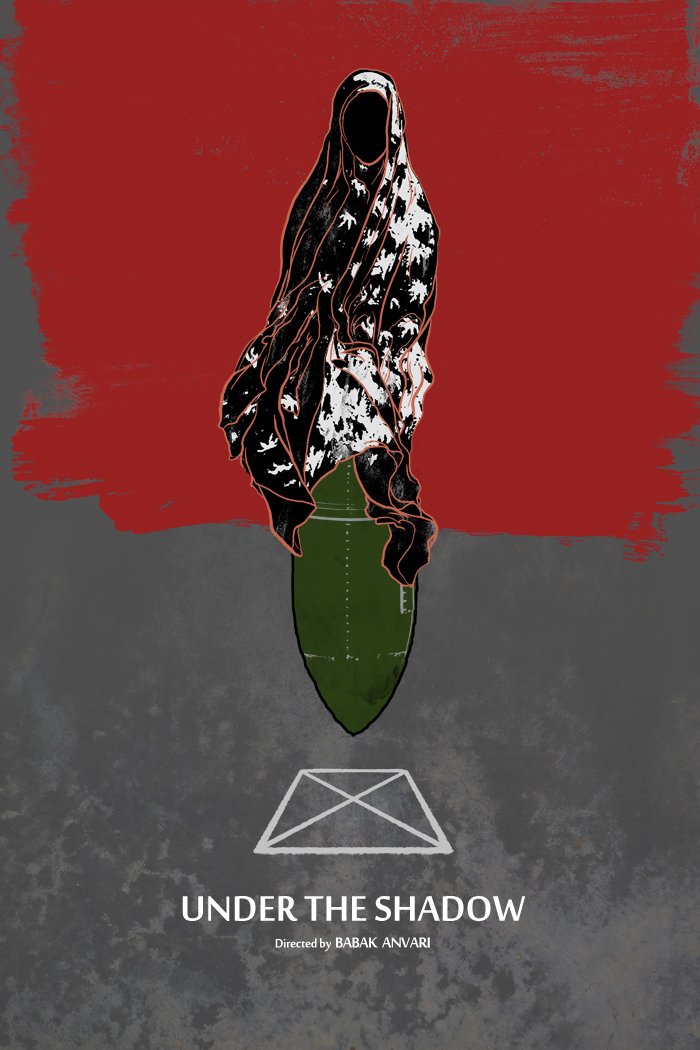
Under the Shadow is a horror movie breaking the typical clichés to transmit an important message – one of understanding.
Babak Anvari’s ‘horror story with a message’ has British students discussing the consequences of the cultural aspects of Iran between 1980 – 1988 during the Iran and Iraq war.
Highlighting the ‘behind the scenes’ horrors of this war, what better way to emphasize the ‘shock factor’ than in a horror? Most of the frights come from Anvari’s use of the ‘jump scare’ in a few scenes but leaving the real reactions from its content – shinning a light on the affects of war upon the Iranian families.
Shideh, a woman, wife and mother living in Iran during the war between Iran and Iraq, is introduced in the film as a woman feeling crushed and trapped by the new cultural enforces of her country. Being refused re-entry into medical school following her politically active past, we are shown the desperation and frustration felt by our protagonist. Anvari works well to depict the image of Shideh as being trapped in the regime and having no options open to her to change her fate. Women were being repressed and their voices unheard. Shideh is shown throughout this feature as having spells of silent action, giving the viewer the image of her silent frustration.
A crack in Shideh’s ceiling, made by an un-exploded missile dropped by Iraq, grows larger throughout the action, reaching out across the surface creating a visual representation of the ever growing lack of control Shideh has over her life. We see her falling apart and unfortunately masking tape will not fix her problems for long. This however, is all she has – she cannot hold things together for long. We see Shideh’s monotone reactions to the events around her, feeling this to be the norm for her and other women of her time. It is almost as if she is accepting of her fate and life, and it would take something big to move her, something shocking to have her leave her home. Well this is what she receives; An evil spirit also know as a Djinn, in the form of a floating hijab. The material prison she begrudges now haunts her family in a physical manifestation.
Students are shocked by the nature of the cultural aspects different from our own. Our own western civil culture being un-relatable when watching life through the actions of Shideh. Shideh’s interactions with the police, especially in her hour of need, leave the audience a little uneasy. She is told “a woman should be scared of exposing herself more than anything”. This is an authentic telling of the views placed upon Iran at the time and the juxtaposition between the Islamic culture and our western culture is shocking.
I have a great appreciation to the deeper meaning depicted within the eye opening, shock factor of Under the Shadow. I am not particularly a fan of horrors but his is one I would happily re-watch again and again. Babak Anvari has succeeded in creating a feature film that speaks to the audience and opens the eyes of the people who underestimated the impact of this war.
 REDSMITHS and ROBINS